Introduction
Hollandaise sauce is a classic emulsified sauce known for its rich and creamy texture, often paired with dishes such as Eggs Benedict. This article details the ingredients needed to create a luscious Hollandaise, along with perfectly poached eggs and an assortment of proteins to complement your meal.
Detailed Ingredients with measures
Hollandaise Sauce
– 3 egg yolks, from large eggs (55-60g / 2 oz each)
– 1/4 tsp cayenne pepper or white pepper
– 1/4 tsp salt
– 1 1/2 tbsp lemon juice, plus more to taste
– 1 1/2 tbsp water, plus more as needed
– 175g / 1 1/2 sticks unsalted butter, cut into 1.5 cm / 1/2″ cubes
Poached Eggs
– 8 large eggs, fridge cold
Protein – Choose One:
– 8 slices bacon – streaky, Canadian (traditional) or other
– 200g / 7oz shaved or sliced ham (16 slices, i.e., 2 slices per muffin half)
– 250g / 8oz smoked salmon slices, at room temp
Assembling
– 4 English muffins, split (or 8 slices of other bread, or 4 brioche or other rolls)
– 1 tbsp each chives and parsley, roughly chopped, for garnish
Prep Time
Preparation Time: 15 minutes
Cook Time, Total Time, Yield
Cook Time: 15 minutes
Total Time: 30 minutes
Yield: Serves 4
This delightful dish is not only a breakfast favorite but is also perfect for brunch or a special occasion. By following the detailed steps outlined in the recipe, anyone can master the art of making Hollandaise sauce and poached eggs while enjoying a meal that’s sure to impress.
Detailed Directions and Instructions
Preparation
Preheat the oven to 50°C/120°F. Cook the bacon in a little oil or butter until it reaches your desired crispiness. Once cooked, transfer the bacon to a small baking pan, cover it with foil, and place it in the oven to keep warm. If using ham, cover it and warm it slightly in the oven. Lightly toast the English muffins and keep them warm on a rack set over a tray.
Hollandaise Sauce
Place the egg yolks in a tall, narrow jug that accommodates the blender stick down to the base. Add water, lemon juice, cayenne pepper, and salt to the jug. Blitz briefly with the blender stick to combine the ingredients. In a heatproof jug, melt the butter until hot, taking care to avoid explosions in the microwave. If using a stove, pour the melted butter into the jug after it is heated. Allow the butter to sit for 15 seconds so the milky whites can settle at the bottom.
With the blender stick running on high, slowly pour the butter into the egg mixture in a thin stream over approximately 45 seconds. Leave the majority of the milky whites behind—about 1.5 tablespoons. Once all the butter is incorporated, the sauce should be thick, creamy, smooth, and pale yellow. Blitz for an additional 10 seconds, ensuring to move the stick up and down to incorporate air.
Assess the thickness of the sauce. If it is too thick, mix in warm tap water one teaspoon at a time until achieving a thickness that is thick but pourable, ensuring it will coat the eggs without being transparent. Transfer the sauce to a bowl, cover, and keep it warm; it will remain warm for about 15 minutes, and room temperature is also acceptable since it will warm upon contact with the hot eggs.
Poached Eggs
To prepare the poached eggs, crack one egg into a small strainer set over a bowl or glass. Allow it to sit for 30 seconds, jiggling gently to let the watery whites strain through. Transfer the strained egg to a teacup. Repeat this process for three additional eggs, using a separate teacup for each.
Fill a large pot with 7.5 cm (3 inches) of water. Bring the water to a boil over high heat. Once boiling, reduce the heat so that small bubbles rise from the base of the pot without large bubbles breaking the surface. Submerge each teacup into the water, gently rolling the egg out onto the base of the pot. Aim to minimize the drop distance for the best shape. Repeat this for all the eggs, ensuring this is done within 15 seconds.
Twenty seconds after the first egg has been added, the eggs should be starting to set. Use a slotted spoon and a dessert spoon to gently turn the eggs upside down, starting with the first egg that went in and ending with the last. Let the eggs poach for one minute, then turn them again. After another 30 seconds, use a slotted spoon to lift one out to check for doneness: the whites should be soft but set, and the yolk should be runny.
Once checked, transfer the poached eggs to a paper towel to drain and allow the tops to dry with residual heat for about 15 seconds. Avoid leaving them on the towel for too long, as they may stick.
Assemble
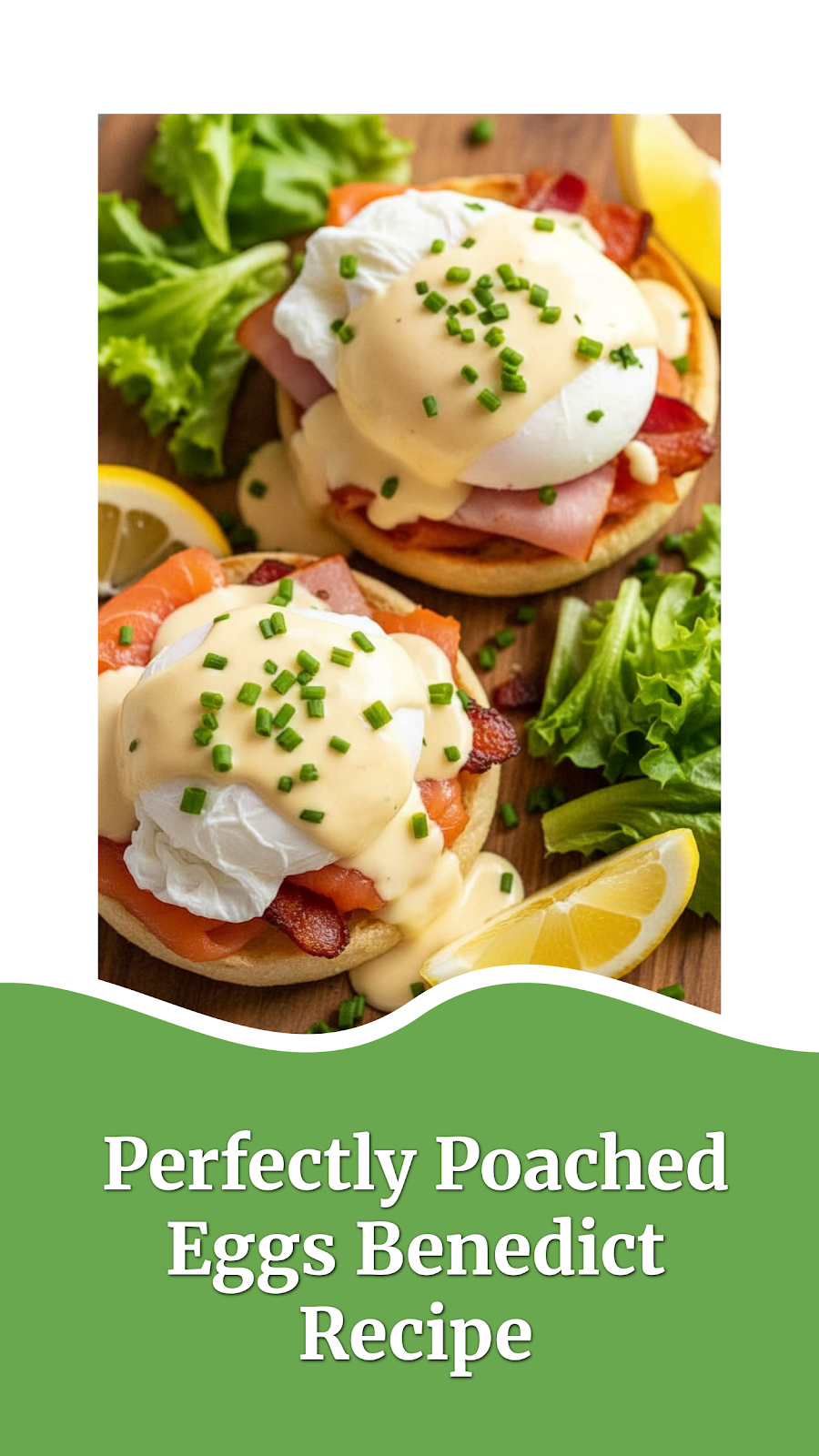
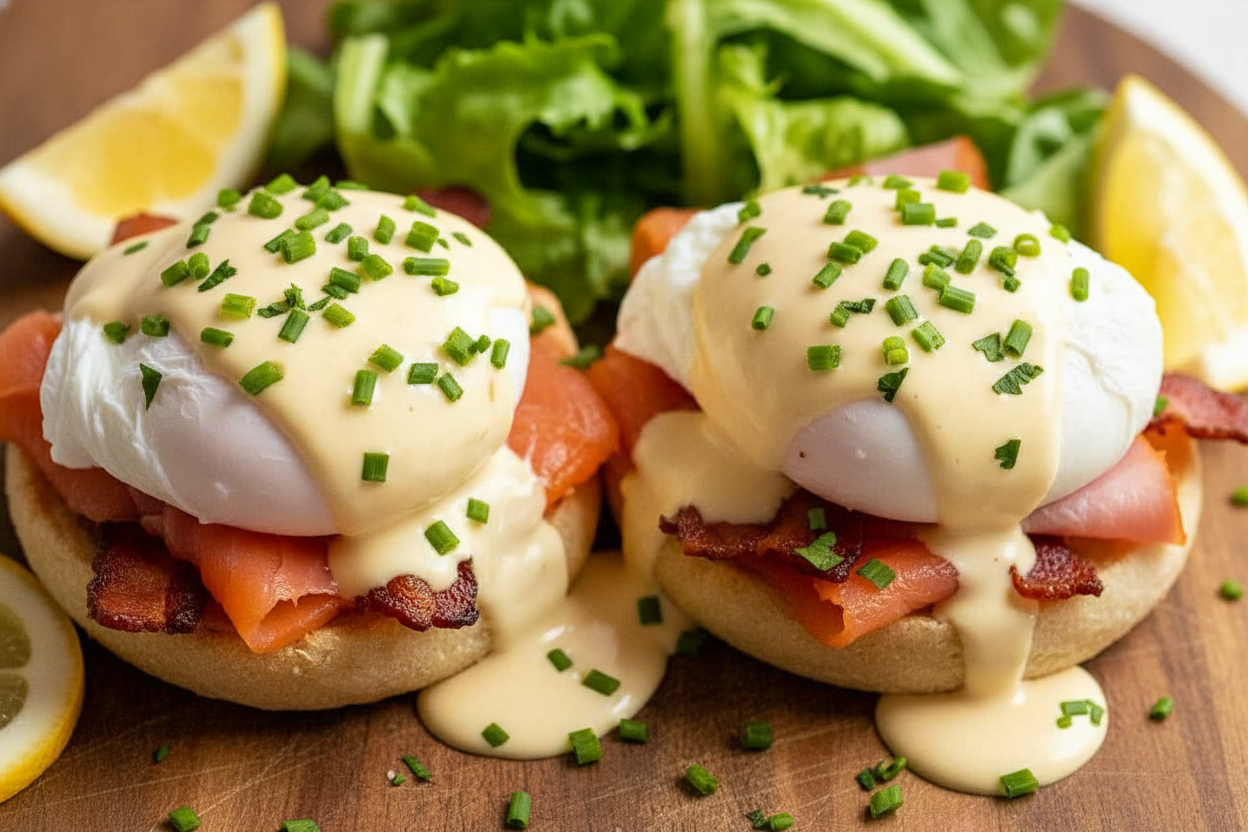
On a plate, place two halves of the toasted English muffins. Layer on your choice of ham, bacon, or smoked salmon. Top each muffin half with a poached egg, spoon over the hollandaise sauce, and sprinkle with chopped parsley and chives. Serve immediately for the best experience.
Notes
1. Egg yolks are easier to separate when they are fridge-cold. You can separate the yolk by passing it back and forth between the broken shell halves or by cracking it into your hands and allowing the whites to slip through your fingers. Ensure you use large eggs, typically weighing 55-60g (2 oz) each.
2. When melting butter, leaving behind the milky whites enhances the flavor of the hollandaise sauce as they contain dairy components. Optionally use clarified butter for an enhanced taste.
3. Fresher eggs yield better poached results due to their structural integrity. Using cold eggs helps contain the whites and forms better poached eggs. Straining also addresses the issue of watery whites for perfect poaching.
4. Use a large pot to ensure ample space for the eggs to roll and poach. Avoid small vessels that may disrupt the poaching process.
5. Ensure the water is at an appropriate temperature: boiling initially gets the heat up, then lowering the heat to maintain gentle water movement is ideal for poaching eggs. Tiny bubbles rising from the pot’s base are acceptable, while the surface should show minor quivering but not rippling.
6. Both poached eggs and hollandaise sauce can be prepared in advance. To store poached eggs, submerge them in cold water post-cooking to halt the process, and refrigerate. To reheat, briefly immerse in boiling water. For the sauce, refrigerate and gently warm it using tap water, stirring until it reaches the desired temperature.
Cook techniques
Making Hollandaise Sauce
Combine egg yolks, water, lemon juice, cayenne pepper, and salt in a tall, narrow jug. Use a blender stick to mix briefly. Melt unsalted butter until hot, allowing milky solids to settle. Slowly pour the clear butter into the egg mixture while blending until thick and creamy. Adjust thickness with warm water if necessary and keep warm.
Poaching Eggs
Strain egg whites from eggs using a small strainer over a bowl, then transfer to teacups. Heat a large pot of water, bringing it to a boil before reducing to a gentle simmer. Submerge the teacup in the water and roll the egg into the pot. Turn the eggs gently after 20 seconds and continue cooking for a total of 1.5 minutes. Check for doneness, then drain on paper towels.
Assembling the Dish
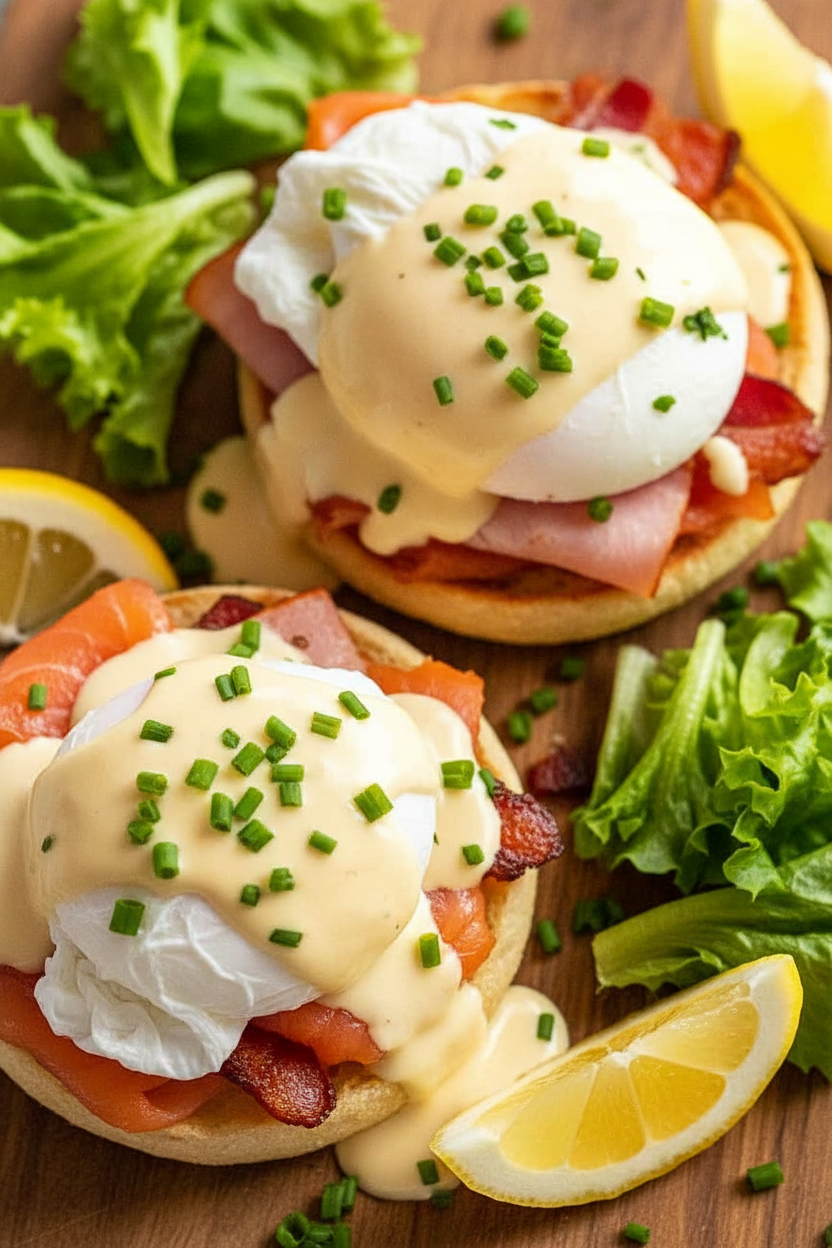
Toast and keep English muffin halves warm. Layer chosen protein (bacon, ham, or smoked salmon) on the muffins, top with a poached egg, drizzle with Hollandaise sauce, and garnish with chopped chives and parsley.
FAQ
Why is it important to strain the eggs before poaching?
Straining the eggs removes watery whites, which helps achieve a better shape and texture during poaching, resulting in a neater presentation.
Can I use clarified butter for Hollandaise sauce?
Yes, using clarified butter or ghee enhances the flavor and creates an even richer Hollandaise sauce by eliminating the dairy solids.
How can I keep the Hollandaise sauce warm without cooking it further?
Transfer the sauce to a bowl, cover it, and keep it warm for up to 15 minutes. To maintain the temperature longer, store it in a warm location or near the stove.
What is the best method for ensuring perfect poached eggs?
Using fresh, cold eggs and gently rolling them into the simmering water minimizes the drop distance, helping the eggs maintain their shape. Adjusting the water temperature to a gentle simmer is also crucial.
Can I prepare poached eggs or Hollandaise sauce in advance?
Yes, both can be made up to 2 days ahead. Poached eggs can be stored in cold water in an airtight container and reheated in simmering water. Hollandaise sauce can be refrigerated and warmed in a bowl of warm water.
Conclusion
This recipe for Hollandaise sauce and poached eggs offers a delicious base for various breakfast dishes. Whether topped on English muffins, ham, bacon, or smoked salmon, it creates a creamy and satisfying meal. With the techniques provided, you’ll master both the sauce and the poaching of eggs, resulting in an elegant dish perfect for any occasion.
Classic Eggs Benedict
English muffins topped with poached eggs, crispy bacon, and rich Hollandaise sauce.
Smoked Salmon Eggs Benedict
Substitute bacon with smoked salmon, and add capers for an upscale twist.
Vegetarian Eggs Benedict
Swap ham or bacon for sautéed spinach and tomatoes, perfect for a light option.
Crab Cake Benedict
Use crab cakes instead of traditional meats for a seafood delight.
Avocado Toast with Poached Eggs
Top avocado toast with poached eggs and drizzle with Hollandaise for a creamy finish.
Breakfast Burrito
Wrap scrambled eggs, cheese, and your choice of protein in a tortilla, and top with a spoonful of Hollandaise.
Shakshuka
Serve poached eggs in spicy tomato sauce with a drizzle of Hollandaise for added richness.
Huevos Rancheros
Combine poached eggs with tortillas, salsa, and beans, then add Hollandaise for a unique fusion.
Hash Brown Nests
Form hash browns into nests, fill with poached eggs, and top with Hollandaise sauce.
Eggs Florentine
Replace the meat with sautéed spinach and artichokes for a healthy, green version of Eggs Benedict.